
Home / Services / Balance & Vertigo Testing
VNG and Ear Balance Tests for Vertigo in Pune
Dizziness and vertigo have a cause, and finding it is the first step to feeling steady again. At Prism Hearing, Speech and Balance in Viman Nagar, we test the inner ear’s balance system with VNG, caloric testing, VEMP and the head impulse test, then guide you on the right treatment path.
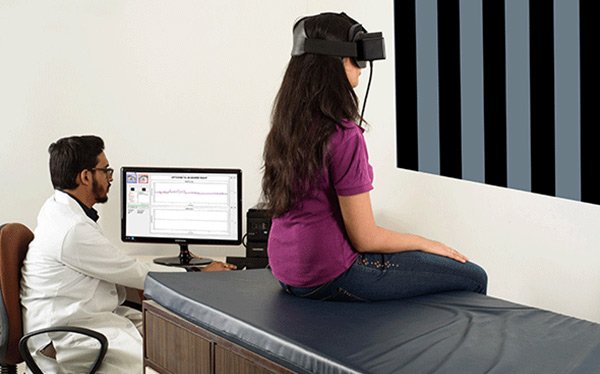
Dizzy, spinning or unsteady? Let’s find out why
Your sense of balance depends on the inner ear, the eyes and the brain working together, helped by signals from your muscles and joints. When something in that system isn’t right, it can show up as vertigo (a spinning sensation), light-headedness, unsteadiness or repeated falls.
An ear balance test, which audiologists call vestibular testing, measures each part of that system objectively, rather than guessing. Once we know which part is involved, and on which side, the right next step becomes much clearer.
Our balance tests
Vestibular testing for balance: what each test checks
Most people have a combination of these tests, chosen from their symptoms and history.
Videonystagmography (VNG)
The main test battery for dizziness. Lightweight video goggles record tiny eye movements while you follow lights and change position, with oculomotor, positional and caloric parts. Because the balance organs steer your eye movements, the pattern shows how your balance system is working. It’s sometimes called a VNG hearing test, but it checks balance, not hearing.
Caloric test
Gentle warm and cool stimulation of each ear canal shows how each inner ear’s balance organ responds, and whether one side is weaker than the other. It’s one of the main ways to tell which ear is involved.
VEMP (cervical and ocular)
Vestibular evoked myogenic potentials measure small muscle responses to sound, in the neck and around the eyes. They check the otolith organs, which sense gravity and straight-line movement, and their nerve pathways, one side at a time.
Head impulse (head-thrust) test
A quick check of the vestibulo-ocular reflex. While you keep your eyes on a target, small, quick turns of your head show how well each ear keeps your vision steady.
Balance problems explained
Balance problems and your inner ear
Balance problems are common, especially as we get older, and most have a cause that can be found. This is a general guide to what an ear balance test looks for. It can’t tell you what is behind your own symptoms, but testing can.
Common causes of balance problems
The inner ear is a frequent source. In benign paroxysmal positional vertigo (BPPV), tiny crystals in the inner ear move out of place and cause brief spinning with certain head movements. Inflammation of the balance nerve, called vestibular neuritis, can bring on sudden, severe vertigo. Ménière’s disease causes attacks of vertigo with ear fullness, ringing and changing hearing. Dizziness can also come from blood pressure, migraine, medication or the brain and nerves. Light-headedness when you stand up quickly, for example, is more often linked to blood pressure than to the ear.
What vestibular testing for balance involves
Most of the assessment watches your eye movements with video goggles (VNG), because the balance organs control the reflexes that keep your eyes steady. The caloric, VEMP and head impulse tests then check each side separately. Together they show whether the problem is likely to be in the inner ear, and on which side. If the pattern suggests a cause outside the ear, we’ll tell you and point you to the right doctor.
Why a hearing test for vertigo?
Hearing and balance share the inner ear, so a hearing test for vertigo is often part of the assessment. A pure tone audiometry test can show a hearing change in one ear that points to that side, and where Ménière’s disease is a question, your audiologist may add ECochG. If ringing in the ears comes with your dizziness, tell us when you book so we can plan tinnitus testing as well.
Go to a hospital emergency department now if
- Dizziness or vertigo comes with weakness or numbness in the face, an arm or a leg, a drooping face or slurred speech.
- You have a sudden, severe headache, double vision or loss of vision, or you can’t walk or stand.
- The dizziness followed a head injury, or comes with chest pain, a racing heartbeat or fainting.
These can be signs of a stroke or another serious problem. Don’t wait for a clinic appointment. Vertigo with a sudden drop in hearing in one ear also needs a doctor or ENT specialist promptly: read our guide to sudden hearing loss.
We can help with
Symptoms and conditions we assess
- Spinning vertigo or a sense of the room moving
- Light-headedness, unsteadiness or frequent falls
- Positional vertigo (BPPV): brief spinning when you move your head or turn over in bed
- Dizziness with ear fullness, ringing or changing hearing
- Balance problems in older adults
Vertigo can have many causes. Testing helps identify them so the right treatment can begin, and we coordinate with your ENT specialist or physician where needed.
What to expect
Plan for about 45 to 60 minutes.
When you book, we’ll tell you if any medicines, caffeine or eye make-up should be paused beforehand.
After your tests
From your VNG test to vertigo treatment
If you’re looking for a VNG test near you, Prism is in Viman Nagar, open all days from 9:30 am to 7:30 pm, and you can book directly without a doctor’s referral.
After the tests, your audiologist explains what they found in plain language. Vertigo treatment depends on the cause. Common approaches include repositioning manoeuvres for BPPV, balance exercises known as vestibular rehabilitation, and medical treatment from an ENT specialist or physician. Where your results point to something beyond our scope, we coordinate with your doctor.
Hearing, speech and balance care all happen under one roof at Prism, for every age, from an infant hearing test for newborns to full balance testing for adults.
Questions
Balance and vertigo FAQs
How do you test which ear is causing vertigo?
What is a VEMP test used for in vertigo diagnosis?
What are the symptoms of inner ear problems in adults?
Is VNG testing uncomfortable?
Do I need a doctor’s referral for balance testing?
How should I prepare for the test?
Take control of your dizziness
Book a vestibular assessment in Viman Nagar and let’s find the cause of your vertigo together.